Test Draft
Published:

Published:
Published:
This digital project maps the routes of travelers escaping slavery in 1855 and 1856 by using Underground Railroad records to create a geography-sensitive database. The resulting maps center the movements of freedom seekers. They also reveal how freedom seekers made their escapes, shedding light on often-overlooked participants in nineteenth-century anti-slavery action.
The words “Underground Railroad” usually conjure up the image of a safehouse. The idea of what this building looked like and who its occupants were has shifted over time as historians uncover more information about freedom seekers and their allies. For example, our hypothetical safehouse almost certainly does not have secret hidden rooms or tunnels, and it is not identifiable by secret signals communicated in quilts or through the placement of lanterns. [1] It might be a townhouse, office, church, or hotel rather than a rural farmhouse; the homeowner might diverge from the stereotypical white Quaker Underground Railroad agent. We might even spare a thought to consider how freedom seekers get to the safehouse, and how they will leave. By train? On foot? Concealed in a wagon? How did they know to go to the safehouse, and where did they come from? Most importantly, where are they going?
Many recent and excellent historical works shed light on these questions. In the past few decades, scholarship has emphasized the role of black Underground Railroad agents, the limits of Underground Railroad organization, the strategies of freedom seekers, and the various means of travel that they used.[2] Despite this, historians are still challenged to write about the experience of freedom seekers who interacted with the Underground Railroad. The most well-recorded parts of their journeys are almost always their visits to safehouses.
If we focus on the places where freedom seekers stopped on their way north, we emphasize the most static parts of their journey. The Underground Railroad was a system of travel. It existed because thousands of people chose to seek their freedom. Their journeys connected the people who helped them, turning disparate abolitionists into supporters of a common goal.
After I moved to Rochester in 2024, I spent a summer as a seasonal park ranger at Harriet Tubman National Historical Park in Auburn, NY. Harriet Tubman is the most recognizable Underground Railroad figure for most people. She led groups of freedom seekers through Auburn, where she eventually settled her family, and to Rochester. In Rochester, Tubman brought freedom seekers to stay with abolitionist writer and speaker Frederick Douglass, who had made his own journey to freedom as a young man.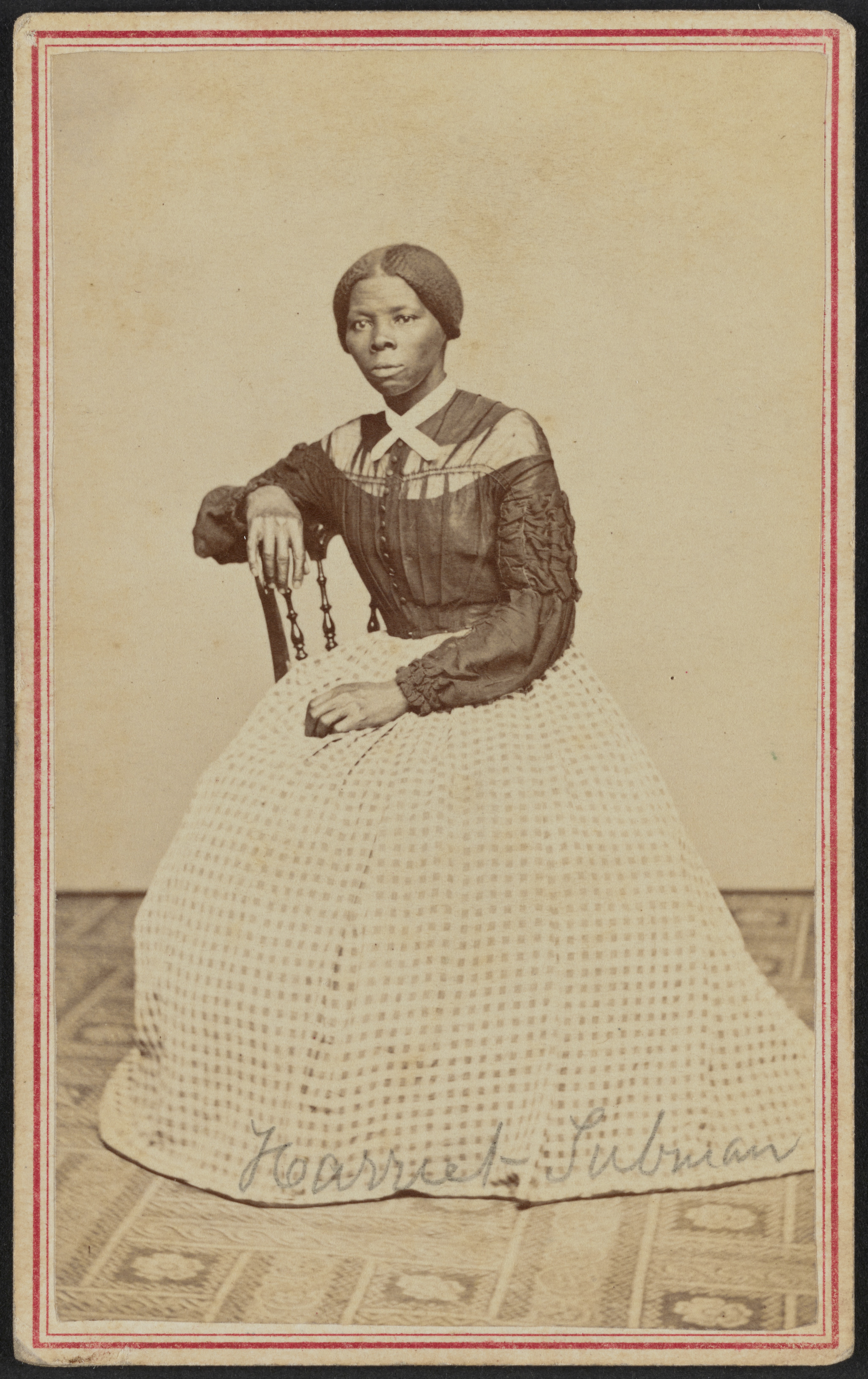
My time as a ranger made me more curious about the freedom seekers who traveled without Tubman’s guidance. As I made the daily commute from my apartment in Rochester (a five-minute drive from the location where Frederick Douglass’s house once stood) to the Harriet Tubman National Historical Park (a five-minute drive from several of the former Underground Railroad sites in Auburn), I wondered how lone freedom seekers made it to Rochester. Where did they travel from? Who directed them to Douglass’s house, and how did they get there? What obstacles did they face?
<arcgis-embedded-map style=”height:600px;width:700px;” item-id=”b3228fc7e3a34fcf91556f4031d2c9af” theme=”light” time-zone-label-enabled center=”-77.055553896555,42.99738297878146”scale=”577790.5542886279” portal-url=”https://urochester.maps.arcgis.com”></arcgis-embedded-map>
This project is meant to depict the geographic journeys of freedom seekers and to explore their experiences of travel, space, and motion.
The most well-known contemporary documentation of the Underground Railroad comes from William Still. As the secretary and chairman of the Pennsylvania Vigilance Committee, Still received almost 1,000 freedom seekers between 1853 and 1861, recording information about each traveller.
 William Still, Chairman of the Vigilance Committee in Philadelphia, ca. 1852-1860, photograph, Ohio History Connection, Wilbur H. Siebert Collection, https://ohiomemory.org/digital/collection/siebert/id/28598.
Through the combined efforts of scholars James McGowan, William C. Kashatus, Nick Sacco, and Jeremy Mennis, Still’s records of freedom seekers are available as a geocoded database. In this dataset, each data entry row represents one person; the geographic information refers to the place from which they escaped.[4] While this information is useful and interesting, it is more a representation of freedom seeker origins than movement. This is likely due, at least in part, to source availability. Most of Still’s records are available in his book, The Underground Rail Road, which he published in 1872—almost 20 years after he began his work with the Vigilance Committee. Clearly, Still had both impressive record-keeping discipline and an impressive memory—his book is nearly 800 pages—but there are places where he omits information due to lack of source material (he straightforwardly announces this in the text of his book, which is a convention that I think modern historians should adopt). The details of freedom seeker narratives are sometimes vague, particularly geographic information. For these reasons, Still’s records did not strike me as the right fit for this project.
Luckily, there is another set of sources. In New York City, Sydney Howard Gay fulfilled a similar role as William Still did in Philadelphia.
 Sydney Howard Gay Portrait, ca. 1850-1888, photograph, Massachusetts Historical Society, Portraits of American Abolitionists, Photo. Coll. 81, Massachusetts Historical Society Photo Archives, Columbia University Libraries Online Exhibitions, https://exhibitions.library.columbia.edu/exhibits/show/fugitives/item/9148.
Unlike Still, however, Gay never wrote a book, and the details included in his records are often sparser but more clear. The two men also had different record-keeping approaches; Still tended to record more personal details (age, appearance, occupation, literacy), while Gay recorded more details about freedom seekers’ travels. Gay’s records are the basis for this project, with Still’s book and other sources often serving as a supplement.
The goal of this project is to turn Gay’s records into a database that records each known location of a freedom seeker as a data point. Rather than having each row of data correspond to one person, each row corresponds to one stage of their journey. For example, a hypothetical freedom seeker who escaped from Baltimore, stopped in Wilmington, Philadelphia, New York, Syracuse, and Rochester, and ended up in Toronto would appear in seven rows of data. Where possible, I have included times and dates of arrivals and departures and transportation information. I have also included the individuals who assisted freedom seekers on their journeys.
This database is unfinished. Gay recorded hundreds of stories, and I anticipate that full data analysis will be a multi-year project. Even without a complete dataset, however, some interesting trends emerge.
Overwhelmingly, the freedom seekers in Gay’s records left slavery of their own volition, without connections to northern abolitionists. The map below indicates locations to which freedom seekers were escorted. Red indicates an escort by a person associated with an abolitionist network, while blue indicates an escort by an anonymous person. Grey indicates no escort.
<arcgis-embedded-map style=”height:600px;width:700px;” item-id=”8ec03e89639142b4a62dce14739e6ca1” theme=”light” scroll-enabled time-zone-label-enabled center=”-77.01692713626792,39.11527966294252”scale=”9244648.868618” portal-url=”https://urochester.maps.arcgis.com”></arcgis-embedded-map>
Nearly all of the instances where abolitionists personally conveyed freedom seekers to a location took place in either Philadelphia or New York—free state locations which freedom seekers would have needed to reach independently. Moreover, the majority of abolitionist escorts in Philadelphia—18 out of 28 instances—were for Jane Johnson, whose escape initiated a high-profile legal case. Johnson returned to the city to testify, and escorts were necessary to protect her from capture.
There are three geocoded instances where a freedom seeker or a group of freedom seekers were escorted by anonymous people. One of these cases involved an adult transporting a group of children. In the other two cases, freedom seekers reached their destinations—Philadelphia and New York, respectively—by ship, and their anonymous escort was a shipboard employee who agreed to hide them.
I’m generally a skeptic when it comes to the public history/academic history split, but the Underground Railroad is one of the historical topics where the division is often pretty clear. The museums, historical societies, and elementary schools of the US are far more interested in the Underground Railroad than the university history departments. Academic historians (who I uncharitably refer to here as a monolithic, generalized group) tend to perceive Underground Railroad history as overly-sentimental and poorly-researched. In many cases, unfortunately, this is true. There are certainly far more buildings and people rumored to be involved with the Underground Railroad than actually were involved. Everyone wants their ancestor or local house museum to have a connection to something significant and heroic; Underground Railroad participation is an easy suggestion to make, and all but impossible to definitively disprove.
I used to work with a historian who once described genealogy as the history equivalent of Pokemon or baseball cards—a form of collecting where the collector’s sense of accomplishment at an acquisition is more significant than the contents or meaning of the collection. At its least factual, Underground Railroad public history can become this type of folklore.
This does a disservice to abolitionists and Underground Railroad helpers by making it seem as though their belief was widespread. It was not. Abolitionism was radical, and people willing to consistently and publicly support it were very few. James MacPherson estimates that not even 10% of US soldiers during the Civil War believed that emancipation was their primary goal.[5] We in the twenty-first century are in the privileged position of knowing that the abolitionists won—slavery was abolished. The people who fought for its abolition might have hoped that it would happen in their lifetimes, but they must have experienced much of the abolition campaign as an interminable uphill battle in which they were vastly outnumbered.
[1] John Michael Vlach, “Above Ground on the Underground Railroad: Places of Flight and Refuge,” in Passages to Freedom: The Underground Railroad in History and Memory (National Underground Railroad Freedom Center and Smithsonian Books, 2004), 108.
[2] Eric Foner, Gateway to Freedom: The Hidden History of America’s Fugitive Slaves (Oxford University Press, 2015), 4, 12–15; Fergus M. Bordewich, Bound for Canaan: The Underground Railroad and the War for the Soul of America (Amistad, 2005), 4; Timothy Dale Walker, ed., Sailing to Freedom: Maritime Dimensions of the Underground Railroad (University of Massachusetts Press, 2021); David Blight, ed., Passages to Freedom: The Underground Railroad in History and Memory (National Underground Railroad Freedom Center and Smithsonian Books, 2004).
[3] Kate Clifford Larson, Bound for the Promised Land: Harriet Tubman, Portrait of an American Hero (Random House, 2005), 92–96.
[7] Benjamin F. Powelson, Carte-de-Visite Portrait of Harriet Tubman, 1868, albumen and silver on photographic paper on card mount, 3 15/16 × 2 7/16 in., Collection of the National Museum of African American History and Culture shared with the Library of Congress, Emily Howland Photograph Album.
[4] William Still, The Underground Rail Road (Porter & Coates, 1872); Jeremy Mennis, “Geospatial Dataset of Cities and Counties of Escape Origin as Recorded in William Still’s Records of the Underground Railroad, 1853-1861,” Journal of Slavery and Data Preservation 6, no. 4 (2025): 258–66; Jeremy Mennis, “Geospatial Dataset of Cities and Counties of Escape Origin as Recorded in William Still’s Records of the Underground Railroad, 1853-1861,” Harvard Dataverse, 2025.
[5] James MacPherson, For Cause and Comrades: Why Men Fought in the Civil War (Oxford University Press, 1997), 117–20.